The BNMA BN Repository
This repository is a resource for posting and downloading Bayesian network models for sharing with others and for providing supporting material for publications. Please respect authors' rights where noted.
Search
17 BNs found.
SongSparrowBDN_v250804
This model provides a decision-aiding tool for determining the efficacy of restoring habitat for Song Sparrow populations in riparian (stream-side) environments otherwise degraded from industrial or other activities. Two decision nodes are provided for types of riparian plantings and for soil treatment, along with their utility costs and inflation adjustments.
BrownTroutBDN_v250804
This model provides a decision advisory tool for determining the efficacy of habitat management for restoring and maintaining brown trout populations in affected stream environments.
35mm B&W Film risk rating 240319 EM
Provides risk ratings for prioritizing which U.S. National Archives and Records Administration records to preserve and archive, for 35mm B&W films.
BCA_Microctonus_NG_RiskAnalysis
BAIPA (for “Biocontrol Adverse Impact Probability Assessment”) is a new probabilistic tool that assesses the potential unwanted impact of organisms released in biological control programmes on non-target species.
The BN integrates information on the potential of an insect parasitoid used in biological control to: (1) disperse in new habitats; (2) interact with non-target species; and eventually (3) negatively impact the populations of the non-target species.
The two exemplar BNs on this repository assess the potential of an insect parasitoid released for biological control of pasture weevils in New Zealand (Microctonus aethiopoides) to disperse in new habitats, interact with on-target species (native weevils in the genus Nicaeana) , and eventually negatively impact the populations of the non-target species. Two habitats are assessed, low-intensity grazing pastures (LIP) and native grassland (NG - this model). Both models were built with GeNIe <bayesfusion.co...>
BCA_Microctonus_LIP_RiskAnalysis
BAIPA (for “Biocontrol Adverse Impact Probability Assessment”) is a new probabilistic tool that assesses the potential unwanted impact of organisms released in biological control programmes on non-target species.
The BN integrates information on the potential of an insect parasitoid used in biological control to: (1) disperse in new habitats; (2) interact with non-target species; and eventually (3) negatively impact the populations of the non-target species.
The two exemplar BNs on this repository assess the potential of an insect parasitoid released for biological control of pasture weevils in New Zealand (Microctonus aethiopoides) to disperse in new habitats, interact with on-target species (native weevils in the genus Nicaeana) , and eventually negatively impact the populations of the non-target species. Two habitats are assessed, low-intensity grazing pastures (LIP - this model) and native grassland (NG). Both models were built with GeNIe <bayesfusion.co...>
FISRAM Freshwater Species 190213
This model is used to determine the degree to which an introduced species of freshwater fish might be invasive and injurious. The model is used by the U.S. Fish and Wildlife Service to help inform on species for potential exclusion of importation.
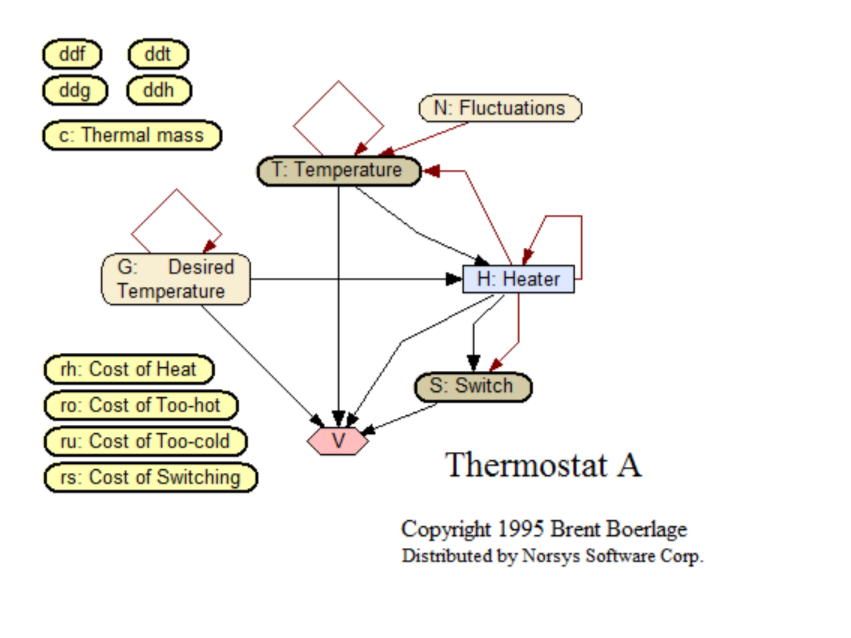
Thermostat A
A time delay decision network for the thermostat-heater control problem. This is a simple example of heater control, with a single heater, single thermal mass, single sensor, and costs for overheating, underheating, energy and switching the heater on and off. It could easily be expanded into a more complex example.
Separable 2
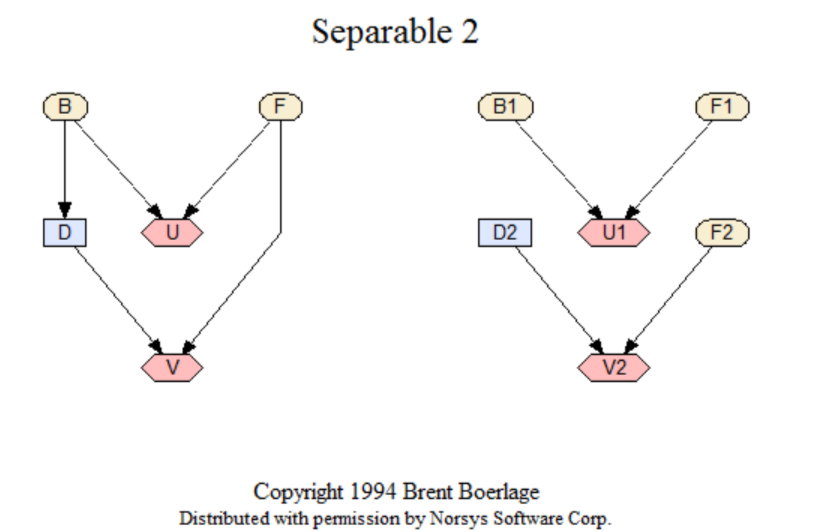
A simple example of a separable (termed 'abnormal' by Zhang) decision net, and the 2 nets it can be separated into. See Separable1 for an even simpler example. This network shows only dependencies, and does not include any numerical relationships.
BN link: <www.norsys.com...>
Separable 1
The simplest example of a separable (termed 'abnormal' by Zhang) decision net, and the 2 nets it can be separated into. This network shows only dependencies, and does not include any numerical relationships.
BN link: <www.norsys.com...>
Oil Wildcatter Simplified
An influence diagram with decisions of whether to do seismic tests for oil, and whether to drill for oil, in order to maximize profits. Same as Oil_Wildcatter, but with some nodes absorbed ('summed out'). In wide usage, but originally from Raiffa68.
Paper link: <www.norsys.com...>
Polar Bear Stressor Model, Phase I (2007-08)
In 2007-08, to inform the U.S. Fish and Wildlife Service decision, whether or not to list polar bears as threatened under the Endangered Species Act (ESA), we projected the status of the world’s polar bears (Ursus maritimus) for decades centered on future years 2025, 2050, 2075, and 2095. We defined four ecoregions based on current and projected sea ice conditions: seasonal ice, Canadian Archipelago, polar basin divergent, and polar basin convergent ecoregions. We incorporated general circulation model projections of future sea ice into a Bayesian network (BN) model structured around the factors considered in ESA decisions. This first-generation (Phase I) BN model combined empirical data, interpretations of data, and professional judgments of one polar bear expert into a probabilistic framework that identifies causal links between environmental stressors and polar bear responses. The BN model projected extirpation of polar bears from the seasonal ice and polar basin divergent ecoregions, where ≈2/3 of the world’s polar bears currently occur, by mid century. Decline in ice habitat was the overriding factor driving the model outcomes.
The Polar Bear Stressor Model, Phase II (2016) can be found here: <abnms.org...>
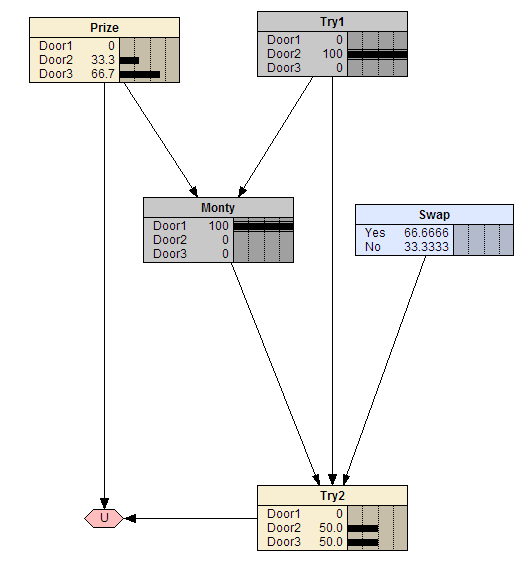
Monty Hall Decision Problem
The Monty Hall problem (see <en.wikipedia.org...>) is a simple counter-intuitive puzzle. There are three doors, two of which have goats behind them and third door, a car. First, you pick a door. Monty then chooses a door with a goat behind it. Now it is up to you: Stay with your door or swap to the other unopened door?
Waterhole Fence
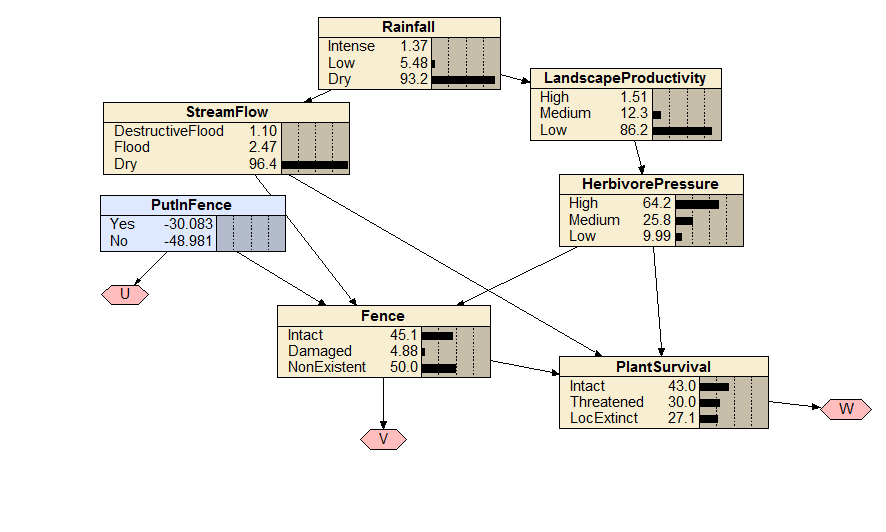
An assessment of the expected value of putting in a fence to promote plant survival, in the face of factors that affect the durability of the fence.
Go Surfing?
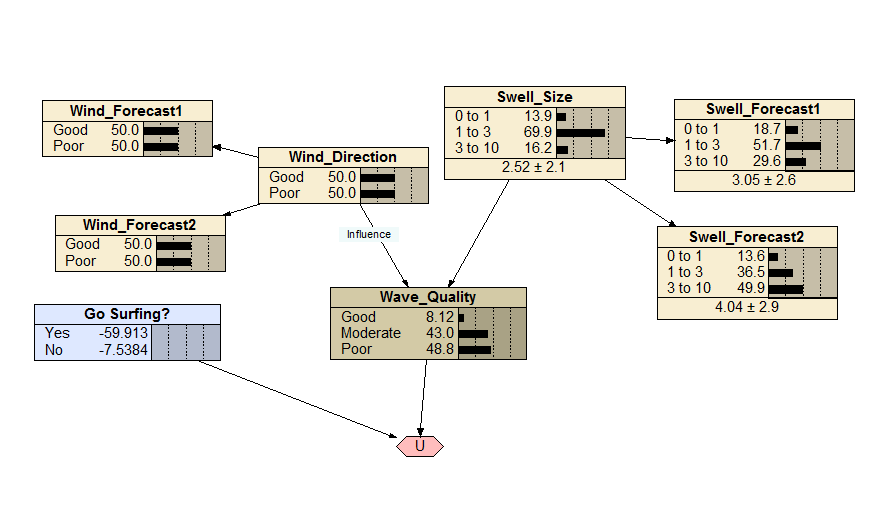
An example decision network for the dilemma of whether or not one should go surfing. The expected value of heading into the surf (or remaining put) is dependent on the wave quality, which is in turn dependent on wind direction and swell size. Both the wind direction and the swell size can be (imperfectly) forecast, and examples of handling these imperfect forecasts are included in the network.
Steroid Use Check
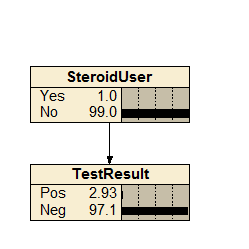
An extremely simple 2-node example demonstrating how true positive/false positive cases can be handled, in this case as applied to a steroid use test.
Amniocentesis Test
A decision network which decides if an Amniocentesis test provides a probability of a positive or negative result given the mother's age. It also provides the probability of a miscarriage should the test not be carried out appropriately. Amniocentesis is a test that can be done on pregnant women to test for certain foetal abnormalities, such as Down’s Syndrome.
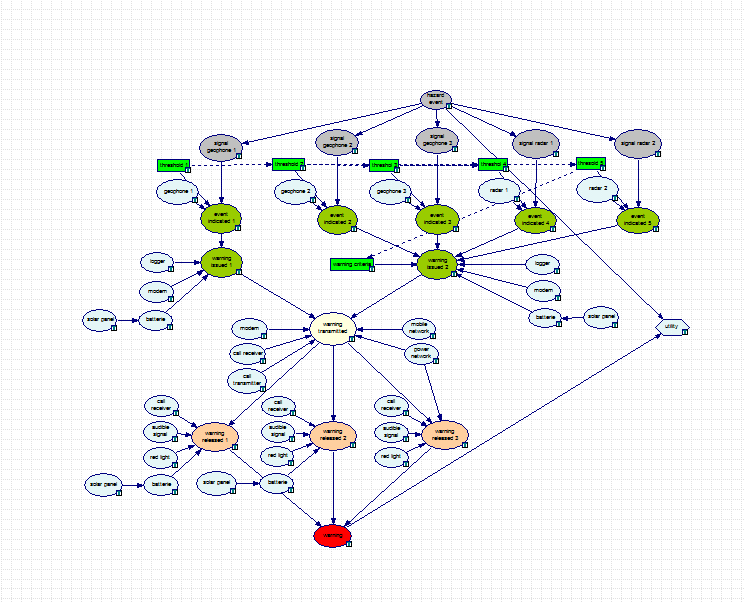
Illgraben Decision Graph
The Decision Graph is applied for the assessment and optimization of an existing threshold-based debris flow warning system. To model the warning system and compute the technical and inherent reliability, the Bayesian Network, which is the Decision Graph without the utility node, can be applied alone. Paper: <www.era.bgu.tum.de...>.