The BNMA BN Repository
This repository is a resource for posting and downloading Bayesian network models for sharing with others and for providing supporting material for publications. Please respect authors' rights where noted.
Search
10 BNs found.
SpiegelhalterDLC93
A 20 node example of a belief net for medical diagnosis. This file does not contain the numerical probabilities (except those few given in the paper). This, together with the paper, provide a good worked out example for clique tree (i.e. join tree) compiling and propagation.
Paper link: <www.norsys.com...>
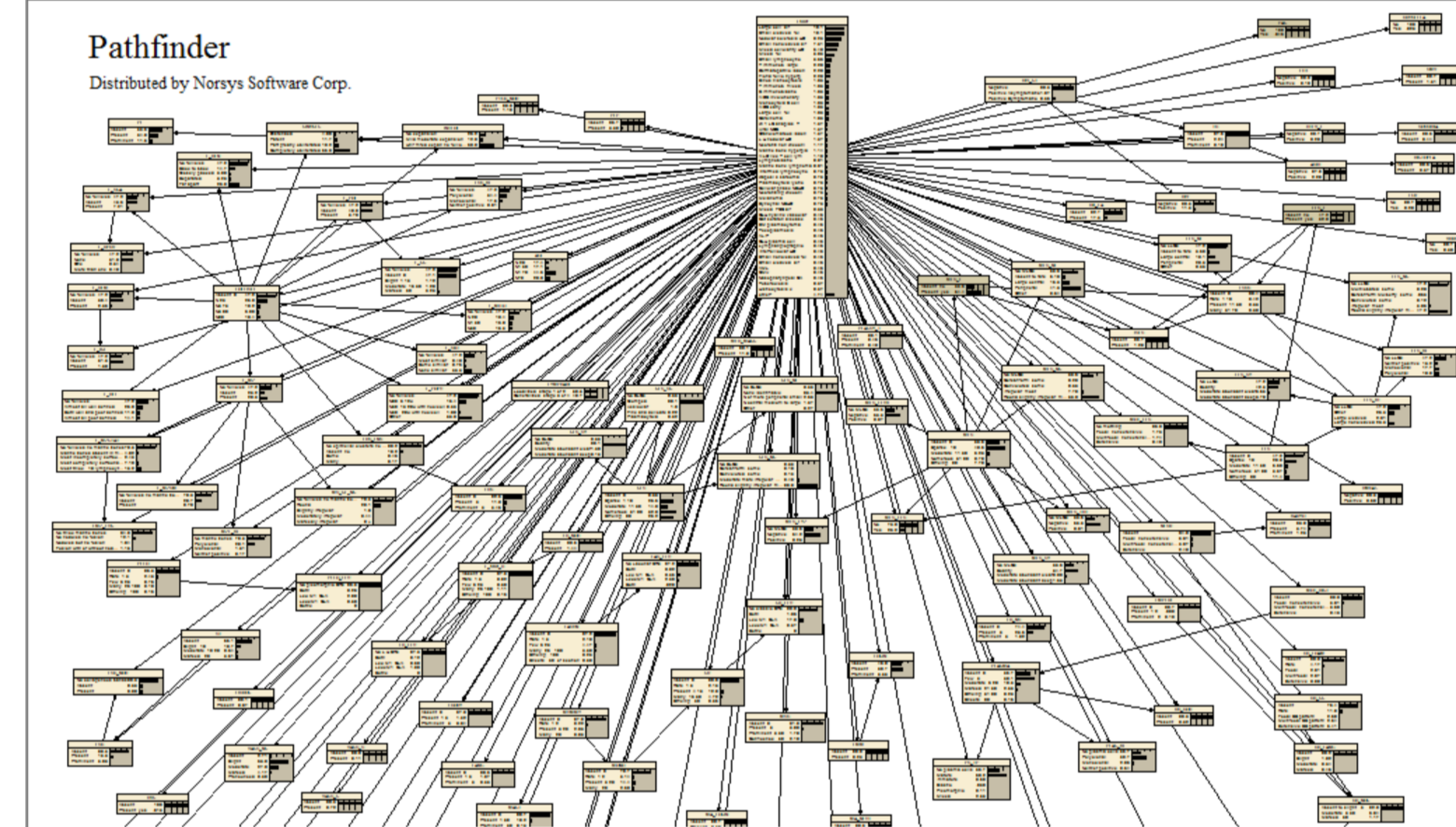
Pathfinder
An expert system that assists surgical pathologists with the diagnosis of lymph-node diseases.
Paper link: <www.norsys.com...>
Neapolitan90
From the book Neapolitan, Richard E. (1990) Probabilistic Reasoning in Expert Systems: Theory and Algorithms, John Wiley & Sons, New York, p. 259. Started as problem 5.5.2, p.183, it becomes example 7.5, p. 261 (with diagram on p. 259), and continues numerically on p. 279. Originally based on the Lauritzen & Spiegelhalter 1988 paper.
BN link: <www.norsys.com...>
Bull Trout Food Web
This model illustrates potential food web and species interaction dynamics related to interactions between bull trout (Salvelinus confluentus) and anadromous salmonid fish existing in the same river system. (Explanation of nodes: small bull trout = at least juveniles and possibly resident adults; terrestrial wildlife predators = some amphibians, reptiles, birds, and mammals; juvenile [juv.] anadromous salmonids eaten = average annual percentage of total juvenile anadromous salmonids that are consumed by fish and other predators; juvenile anadromous salmonids = parr to smolt stages, although some bull trout predation on eggs also occurs; popn = population; anadromous reproduction = number of offspring [embryos] produced by spawning adult salmonids; other sources of mortality = poor water quality, passage through reservoirs and past dams, natural disturbances, etc.).
Polar Bear Stressor Model, Phase I (2007-08)
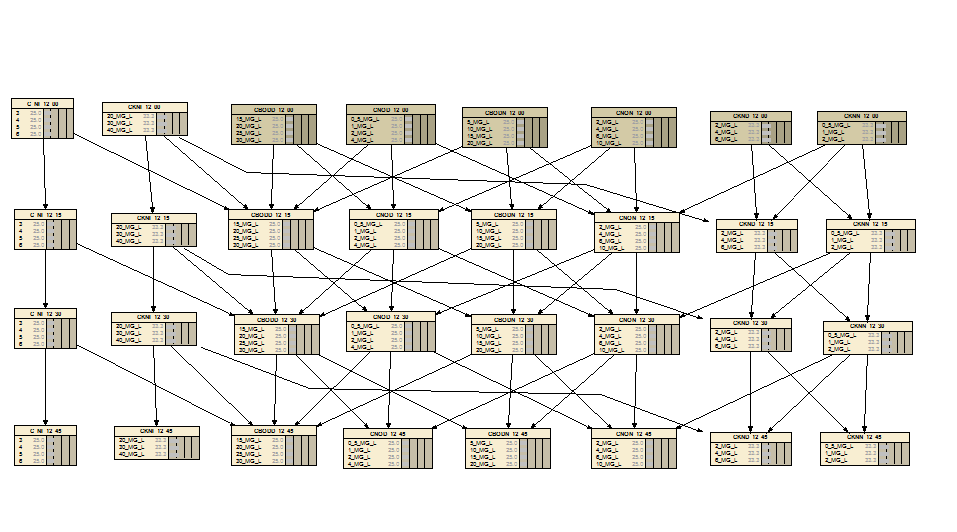
In 2007-08, to inform the U.S. Fish and Wildlife Service decision, whether or not to list polar bears as threatened under the Endangered Species Act (ESA), we projected the status of the world’s polar bears (Ursus maritimus) for decades centered on future years 2025, 2050, 2075, and 2095. We defined four ecoregions based on current and projected sea ice conditions: seasonal ice, Canadian Archipelago, polar basin divergent, and polar basin convergent ecoregions. We incorporated general circulation model projections of future sea ice into a Bayesian network (BN) model structured around the factors considered in ESA decisions. This first-generation (Phase I) BN model combined empirical data, interpretations of data, and professional judgments of one polar bear expert into a probabilistic framework that identifies causal links between environmental stressors and polar bear responses. The BN model projected extirpation of polar bears from the seasonal ice and polar basin divergent ecoregions, where ≈2/3 of the world’s polar bears currently occur, by mid century. Decline in ice habitat was the overriding factor driving the model outcomes.
The Polar Bear Stressor Model, Phase II (2016) can be found here: <abnms.org...>
Recreation Effects on Brown Bears
We integrated results from empirical studies with expert opinion to better understand the potential population-level effects of recreational activities on brown bears. We conducted a literature review and Delphi survey of brown bear experts to better understand the frequencies and types of recreations occurring in bear habitats and their potential effects, and to identify management solutions and research needs. We then developed a Bayesian network model that allows managers to estimate the potential effects of recreational management decisions in bear habitats.
Hailfinder
A network that uses meteorological data with expert judgements to forecast weather in Northeastern Colorado.
Child
A network modelling symptoms of disease and birth asphyxia in a child.
Asia
Sample network showing probability of lung cancer given certain factors, alongside some symptoms.