The BNMA BN Repository

This repository is a resource for posting and downloading Bayesian network models for sharing with others and for providing supporting material for publications. Please respect authors' rights where noted.

Search

7 BNs found.

35mm B&W Film risk rating 240319 EM

Provides risk ratings for prioritizing which U.S. National Archives and Records Administration records to preserve and archive, for 35mm B&W films.

Bruce G. Marcot
Netica .dne format
Technology
Shark management survey analysis

In our recently published article “A scenario study of the acceptability to ocean users of more and less invasive management after shark-human interactions”, Bayesian Network (BN) was chosen as the principal analysis tool for identifying patterns from a study of 1769 valid responses from a survey which was open to all Australian residents aged 18 or over. The study was aimed to (1) Improve understanding of community attitudes in NSW to shark management options, and (2) Improve understanding of contextual influences on attitudes to shark bite mitigation approaches and how authorities should respond following an interaction. A modified BN model (26 nodes, 54 links) was proposed (implemented in Netica version 6.09) to improve the prediction performance of those four variables of risk management policy/strategy in the original BN model (26 nodes, 44 links) (implemented in Netica version 6.05)

John Xie
Netica .dne format
Simmons, P., Mehmet, M., Curley, B., Ivory, N., Callaghan, K., Wolfenden, K. & Xie, G. (2021) A scenario study of the acceptability to ocean users of more and less invasive management after shark-human interactions. Marine Policy, 129:104558
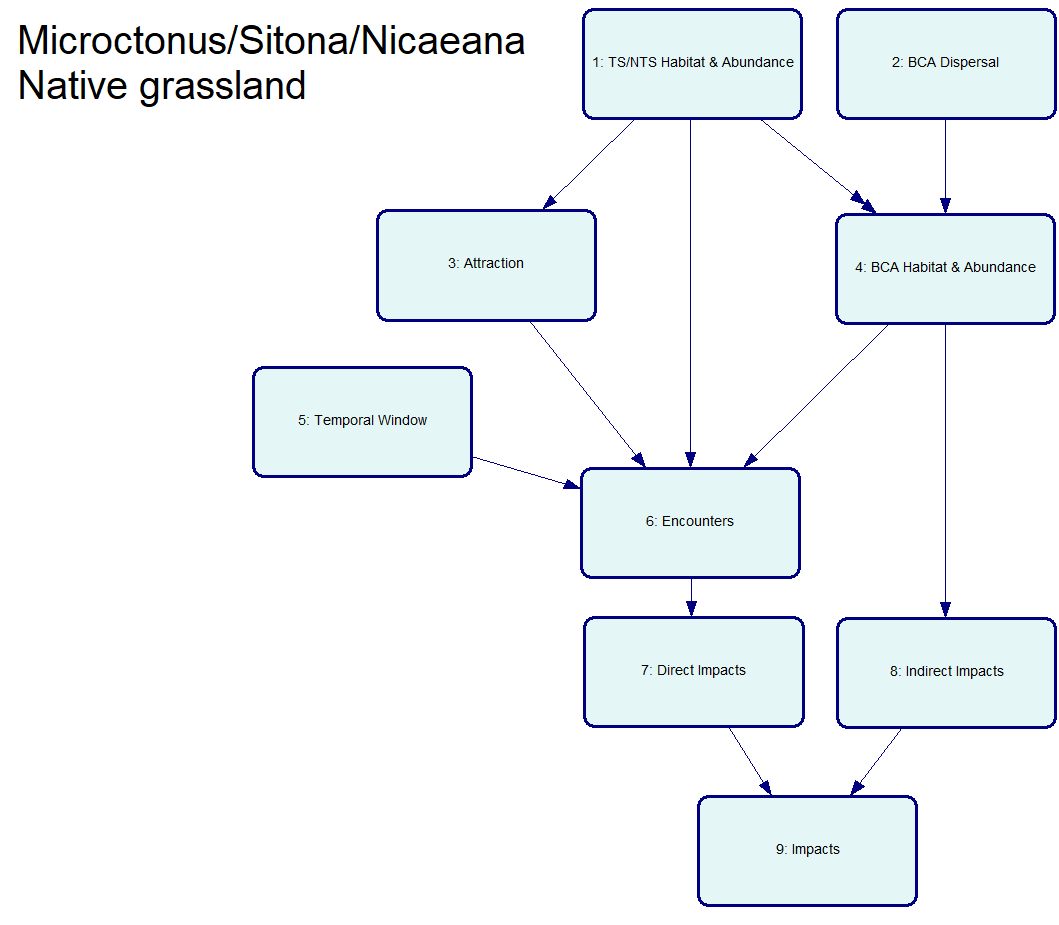
BCA_Microctonus_NG_RiskAnalysis

BAIPA (for “Biocontrol Adverse Impact Probability Assessment”) is a new probabilistic tool that assesses the potential unwanted impact of organisms released in biological control programmes on non-target species.

The BN integrates information on the potential of an insect parasitoid used in biological control to: (1) disperse in new habitats; (2) interact with non-target species; and eventually (3) negatively impact the populations of the non-target species.

The two exemplar BNs on this repository assess the potential of an insect parasitoid released for biological control of pasture weevils in New Zealand (Microctonus aethiopoides) to disperse in new habitats, interact with on-target species (native weevils in the genus Nicaeana) , and eventually negatively impact the populations of the non-target species. Two habitats are assessed, low-intensity grazing pastures (LIP) and native grassland (NG - this model). Both models were built with GeNIe <bayesfusion.co...>

Meurisse, Nicolas and Marcot, Bruce G. and Woodberry, Owen and Barratt, Barbara I. P. and Todd, Jacqui H.
GeNIe 2.0 XML format
Meurisse, N., Marcot, B.G., Woodberry, O., Barratt, B.I.P. & Todd, J.H. (2022) Risk Analysis Frameworks Used in Biological Control and Introduction of a Novel Bayesian Network Tool. Risk Analysis, 42(6):1255-1276
Biology > Ecology
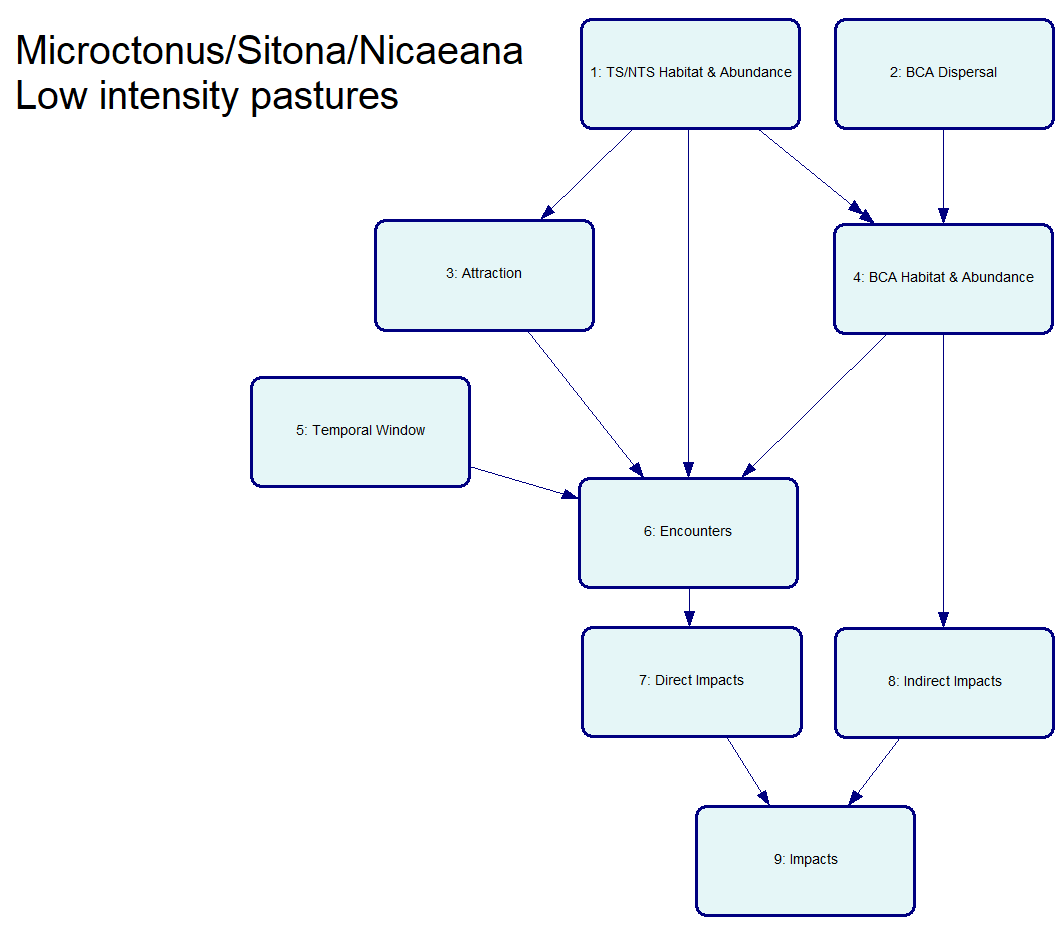
BCA_Microctonus_LIP_RiskAnalysis

BAIPA (for “Biocontrol Adverse Impact Probability Assessment”) is a new probabilistic tool that assesses the potential unwanted impact of organisms released in biological control programmes on non-target species.

The BN integrates information on the potential of an insect parasitoid used in biological control to: (1) disperse in new habitats; (2) interact with non-target species; and eventually (3) negatively impact the populations of the non-target species.

The two exemplar BNs on this repository assess the potential of an insect parasitoid released for biological control of pasture weevils in New Zealand (Microctonus aethiopoides) to disperse in new habitats, interact with on-target species (native weevils in the genus Nicaeana) , and eventually negatively impact the populations of the non-target species. Two habitats are assessed, low-intensity grazing pastures (LIP - this model) and native grassland (NG). Both models were built with GeNIe <bayesfusion.co...>

Meurisse, Nicolas and Marcot, Bruce G. and Woodberry, Owen and Barratt, Barbara I. P. and Todd, Jacqui H.
GeNIe 2.0 XML format
Meurisse, N., Marcot, B.G., Woodberry, O., Barratt, B.I.P. & Todd, J.H. () Risk Analysis Frameworks Used in Biological Control and Introduction of a Novel Bayesian Network Tool. Risk Analysis, n/a(n/a):
Biology > Ecology
Reactor

This example shows that introducing a common cause can make an important change, even if the maringal probabilities of the children remain the same.

Catastrophic failure occurs only if all 3 subsystems fail.

The probability of Catastrophic_Failure1 (with no findings) is 2.9791e-011, which may be an acceptable risk.

However, more careful modeling leads to the addition of the Incorrect_Test_Procedure node. With only this change, the failure probability jumps to 0.003%, which is unacceptable.

Notice that the failure probability of the subsystems remains 0.031% in both cases, and the CPT of Catastrophic_Failure remains unchanged.

BN link: <www.norsys.com...>

Norsys Software Corp
Netica .dne format
Industry
Amniocentesis Test

A decision network which decides if an Amniocentesis test provides a probability of a positive or negative result given the mother's age. It also provides the probability of a miscarriage should the test not be carried out appropriately. Amniocentesis is a test that can be done on pregnant women to test for certain foetal abnormalities, such as Down’s Syndrome.

Dan Rogers
Netica .dne format
Medicine
Fuel Breaks

The model examines the role of the landscape, fuel load, fuel moisture and fuel breaks on changing the risk to property in San Diego County, USA.

Trent Penman
GeNIe 2.0 XML format
Penman, T., Collins, L., Syphard, A.D., Keeley, J.E. & Bradstock, R. (in press) Influence of fuels, weather and the built environment on the exposure of property to wildfire.. PLoS ONE, Accepted 12 September 2014